

 I admit it. I’m a little biased, but I truly believe that Oracle Eloqua is the most robust and flexible enterprise marketing automation software out there. Being the leading platform that it is allows me to fulfill my passion for helping marketing organizations get the most out of their technological investments. Over the past several months, I’ve noticed an increased desire from enterprise clients to be more strategic with respect to how their marketing automation platform is deployed and being used.
In large companies, it’s not uncommon for there to be different and disparate technology solutions in place across an organization, and they may have similar purposes. One business unit brings in a CRM and a MA (marketing automation) platform. A different business unit goes with different technology. Before you know it, you’ve got several CRMs running and numerous MA platforms all meeting similar business needs. This makes it tricky to get a real sense of all that is going on for outbound/inbound marketing and consumer engagement. On the sales side of the house, the trend to scuttle these siloed systems has been going on for some time. CIOs, CTOs and EVPs of sales have recognized that having all sales data living in one place is crucial for visibility, efficiency, and reporting.
Unfortunately, the marketing side is only just now catching up. I have to assume this is a result of many of the hungry sales people hyping their MA solution as being “enterprise ready” when in fact very few can handle such complexity. It is incredibly difficult and frustrating when you’re attempting to stretch a MA platform beyond what it can realistically do. You’ll waste a ton of time and money trying to make a tool built for SMB and mid-market organizations into something that works for the global Fortune 1,000.
As the enterprise looks to consolidate all these disparate systems into a global marketing automation platform, I find them choosing Oracle Eloqua time after time.
If your organization is moving in this direction, there are a few different ways you can deploy Oracle Eloqua to solve the scale and complexity of the enterprise. Here are the 3 most common ways: 
1) Unified System
A unified system is a single Oracle Eloqua instance that is shared across the entire organization and all geographies. It is the most common deployment we see and it’s what we normally recommend to our enterprise clients.
When is this used?
This approach is used in organizations that have a single/unified CRM system, can set up and maintain global marketing automation/demand center governance, want a unified/shared view of all marketing touch-points, and have shared lead management processes across the organization.
Why should you go this route?
Use this approach to create a single unified source of all marketing/demand generation activities shared across the organization, establish a globalized view of a customer, and maintain consistency and control over brand and messaging.
What do you need to make this successful?
Our recommendation is to create a global demand center of excellence to oversee all system of governance needs. Once you have your demand center of excellence in place, establish an internal certification and on-boarding program to ensure people are properly trained on how to use the platform within the context of your business environment.
Additionally, you may want to set up contact level security tools that incorporate all the needs of the respective business units. In short, contact level security (CLS) allows users to have filtered access to the contact database based on rules that you set up. For example, if I am Director of Marketing for North America, I may not be able to see or market to any contacts that are not in North America.
With a Unified System, it’s vital to establish workflow approvals and strict naming convention guidelines for content, assets, and data loads that you put into the system. This will help ensure data accuracy and simplify the ability to find resources in the system. 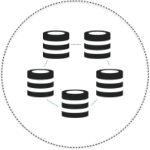
2) Distributed Environment
A distributed environment is created using individual Oracle Eloqua instances that are typically based on geographical area and/or business units that operate autonomously but are interconnected to allow data to flow between them.
When is this used?
This approach is used in organizations that have a multiple CRM systems, lack control over global marketing automation/demand center governance, have unique business unit or country-specific lead management processes, or require physical isolation of system data.
Why should you go this route?
A distributed environment allows you to manage the unique lead management processes, integration and data management requirements for autonomous business units and/or country-specific needs while allowing data to be shared throughout the organization.
What do you need to make this successful?
While not as robust as the unified system, creating a global demand center of excellence committee is key in this approach as well. Members from each business unit or geographic region should sit on the committee. As a group, the committee decides how to implement system governance as a whole and then adapts to meet the needs of each individual
. You should additionally establish a corporate sanctioned internal certification and on-boarding program and corporate standards for data management, naming conventions, list management processes, etc.
The committee should develop a plan for creating and sharing assets and establish rules for subscription/preference management between the different systems. For example, if a contact unsubscribes from one business unit’s emails, should they be unsubscribed from the entire organization? How will that data be shared? 
3) Hybrid
A hybrid of the first two options creates a shared Oracle Eloqua instance for core marketing efforts across an entire organization/geographies that is supplemented by a small number of connected business unit/country/ data restricted instances.
When is this used?
This approach is taken in organizations that have a single/unified CRM system, can set up and maintain global marketing automation/demand center governance, want a unified and shared view of all marketing touch-points, have shared lead management processes across the organization, but require support of outlying brands/business units/countries that cannot be standardized for one reason or another.
Why is this used?
A hybrid creates a single unified source of all marketing/demand generation activities shared across the organization, allows for a globalized view of a customer, and establishes consistency and control over brand and messaging while also accounting for outliers that require their own instance due to unique situations.
What do you need to do to make this successful?
The same success measures as the Distributed Environment apply to this model, as they are essentially the same, just with a larger portion of the organization being represented by a primary instance.
These are the three ways we see larger organizations structuring a global rollout of an enterprise-level marking automation platform like Oracle Eloqua. If your organization is moving in this direction, we would love to talk through the pros and cons of each of these options and what specific considerations would need to be addressed as you look to streamline and standardize your global marketing efforts.
Share This
About the Author: Relationship One